

The Renters' Rights Act 2026 - A Complete Guide for Landlords

The Renters’ Rights Act 2025 introduces the most significant reforms to the private rented sector in decades.
From the abolition of fixed-term tenancies and Section 21 to new rent increase rules and strengthened tenant rights, the way landlords operate will fundamentally change from 1 May 2026. Early preparation is essential.
This post explores:
- The Renters' Rights Act implementation roadmap.
- The timeline for the Renters' Rights Act.
- The key changes in the Renters' Rights Act that will affect landlords.
- Practical steps landlords should take now to prepare for new renters' rights.
What Is the Timeline for the Renters’ Rights Act 2025?
Understanding the timeline for the Renters’ Rights Act is crucial.
1 May 2026 - Phase 1
Phase 1 of the Renters’ Rights Act comes into force on 1 May 2026 and focuses on core tenancy reform:
- All fixed-term Assured Shorthold Tenancies (ASTs) will be abolished.
- Any new tenancies must be issued as Assured Periodic Tenancies.
- Section 21 notices will be removed, and landlords seeking possession must rely on Section 8, which will include enhanced grounds.
- There will be a standardised procedure for rent increases.
- There will be increased tenant rights, including requests to keep pets and discrimination protections.
Late 2026 - Phase 2
By late 2026, the Private Rented Sector (PRS) Landlord Database and a new Private Rented Sector Ombudsman will be introduced.
2035 (or sooner) - Phase 3
The Decent Homes Standard (DHS) and Awaab’s Law (damp and mould) standards are to be implemented.
What Are the Most Important Changes for Landlords Under the Renters’ Rights Act?
1. The End of Fixed-Term Tenancies
From 1 May 2026:
- Landlords cannot grant fixed-term ASTs.
- All new tenancies must be Assured Periodic Tenancies.
- Tenancies will roll monthly.
The government will shortly publish prescribed wording for tenancy agreements.
We are reviewing our templates and will be updating these in readiness for the deadline. These will then replace the ASTs which are currently available for download.
What Will Happen to Existing Tenancies Under the Renters' Rights Act?
- All existing ASTs or Periodic tenancies granted before 1 May 2026 will automatically convert to the new tenancy structure on 1 May 2026.
- Landlords do not need to issue a new tenancy agreement for existing tenancies.
- Landlords will be required to serve a prescribed information sheet to existing tenants by 31 May 2026 detailing the new rules.
The government is expected to publish the prescribed wording by March 2026.
Landlords can continue to use the range of AST templates available until the new changes come into force.
How Will the Renters’ Rights Act Impact Student Tenancies?
Academic-year fixed terms will no longer be available from 1 May 2026. Instead:
- Student tenancies must be periodic.
- New student-specific possession grounds will apply.
- Mandatory wording must be included in agreements.
We are reviewing our templates and, as soon as the government has released its prescribed wording to be included in tenancies, these will be ready to download.
2. The Abolition of Section 21 Notices
From 1 May 2026:
- Section 21 or “no fault” eviction notices will be abolished.
- Landlords must rely on revised Section 8 grounds.
Can Section 21 Still Be Used Before 1 May 2026?
If a valid Section 21 notice is served before 1 May 2026, possession proceedings may be issued until the earlier of the expiry of the notice or 31 July 2026. After that point, Section 21 will no longer apply.
Landlords should familiarise themselves with the Section 8 process now.
3. Section 8 Changes
To compensate for the removal of Section 21, new and amended grounds will be introduced, including:
- Mandatory possession where a landlord intends to sell.
- Mandatory possession for landlord or family occupation.
- Revised rent arrears thresholds.
- New student-specific possession grounds.
4. A Standardised Procedure for Rent Reform
From 1 May 2026:
- Rent review clauses will no longer be valid.
- All rent increases must follow the Section 13 statutory procedure.
- A minimum of two months’ notice must be given.
- Tenants can challenge increases at the Tribunal.
5. Discrimination Protections for Tenants
Under the Renters’ Rights Act, landlords must not discriminate against potential tenants because they receive benefits or have children. Adverts such as “No DSS” will also be made unlawful.
6. Pet Requests
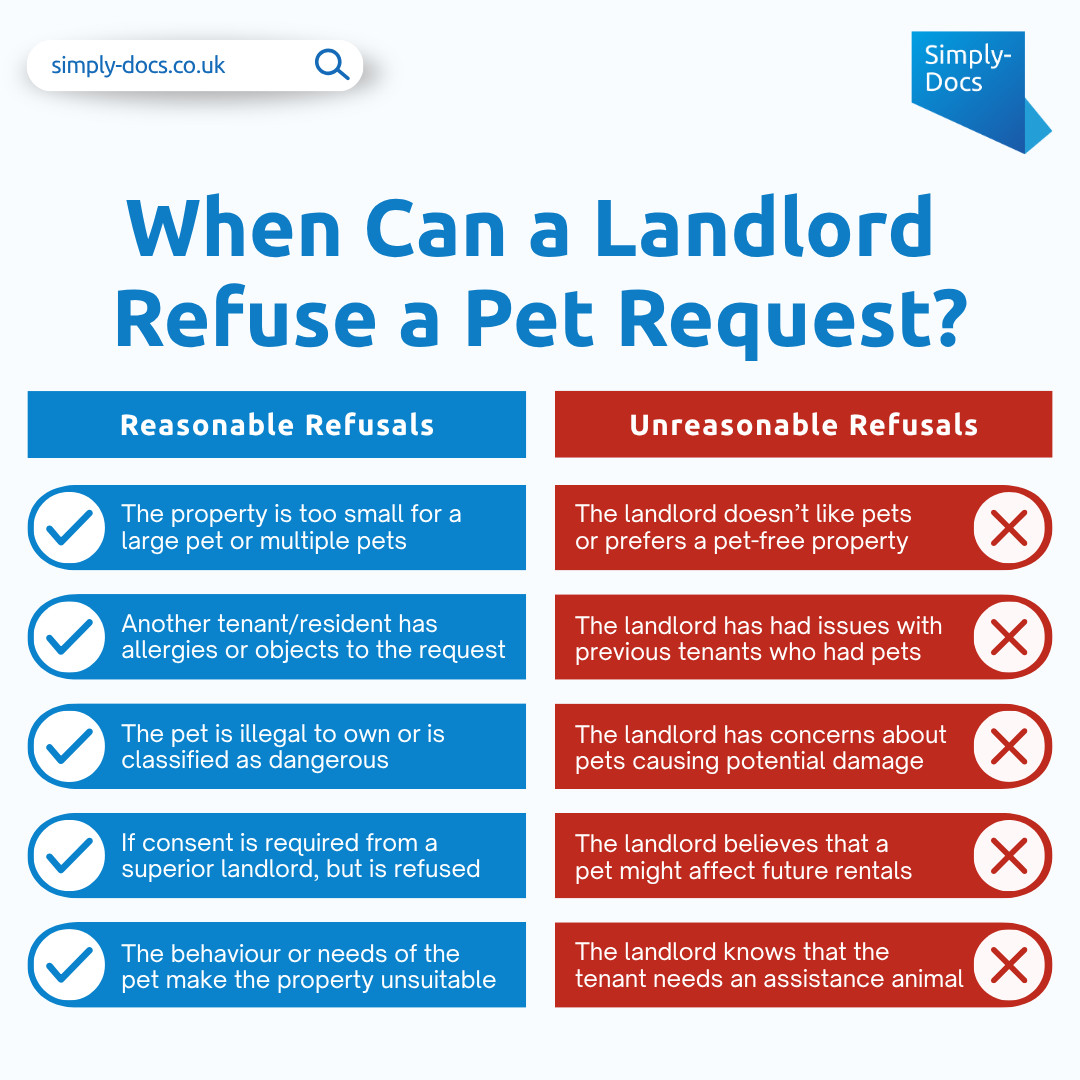
In addition, tenants may request permission in writing to keep a pet, and landlords must consider the request within a strict timeframe and not unreasonably refuse. An unreasonable refusal may result in a tenant applying to the courts for consent.
Explore our collection of Pet Consent Templates for Residential Landlords here.
7. Restrictions on Rent in Advance
Landlords may only request one month’s rent in advance after the tenancy agreement has been signed.
Landlords must not accept, encourage or invite tenants to pay rent above the amount advertised.
8. Financial Risk for Non-Compliance
Local authorities can issue civil penalties of up to £7,000 for breaches. In addition, landlords risk tribunal challenges and the inability to recover possession.
Early preparation will reduce the risk of enforcement action and litigation risk.
Stay subscribed to Simply-Docs for regular updates and additions to our extensive range of templates, documents and guidance!
FAQs
What is the Renters’ Rights Act 2025?
The Renters’ Rights Act 2025 is a major reform of the private rented sector in England. It introduces new rules for landlords with the aim of providing renters with greater security and stability.
When will the Renters’ Rights Act come into force?
The main provisions of the Renters’ Rights Act are expected to come into force from 1 May 2026. It is expected to be implemented in three phases. Phase 1 comes into effect on 1 May, phase 2 will be rolled out in late 2026, and phase 3 will be implemented in 2035 (or sooner).
What are the key protections under the Renters' Rights Act in England?
The key protections under the Renters’ Rights Act include:
- The end of fixed-term tenancies.
- The abolition of Section 21 notices.
- Rent increase limits.
- Discrimination protections for tenants who receive benefits or have children.
- Tenants may request to keep a pet.
- Restrictions on rent in advance.
What are the new rules for landlords in 2026?
From 1 May 2026, the new rules that apply to landlords are:
- Landlords cannot grant fixed-term Assured Shorthold Tenancies.
- Landlords must justify any eviction under enhanced Section 8 grounds.
- All rent increases must follow the Section 13 statutory procedure.
- Landlords must reasonably consider tenant pet requests.
- Landlords may only request one month’s rent in advance after a tenancy agreement has been signed.
- Landlords cannot invite or accept higher offers than those advertised.
- Non-compliance can result in penalties of up to £7,000.